Choosing hospital management software: the one-patient test
Every HMS demo shows a beautiful dashboard. The real test is whether one patient's data flows from registration to discharge without being retyped. A buyer's guide to hospital management software.
The one-patient test
Every hospital management software demo opens on a beautiful dashboard. Ignore it. Instead, follow one patient through the system: registration, OPD consultation, lab order, pharmacy, billing, discharge. At every step, ask one question — did the data flow, or did someone retype it? A hospital that re-enters patient data by hand at any step is not running one system; it is running six systems with the same logo.
Modules are not the same as integration
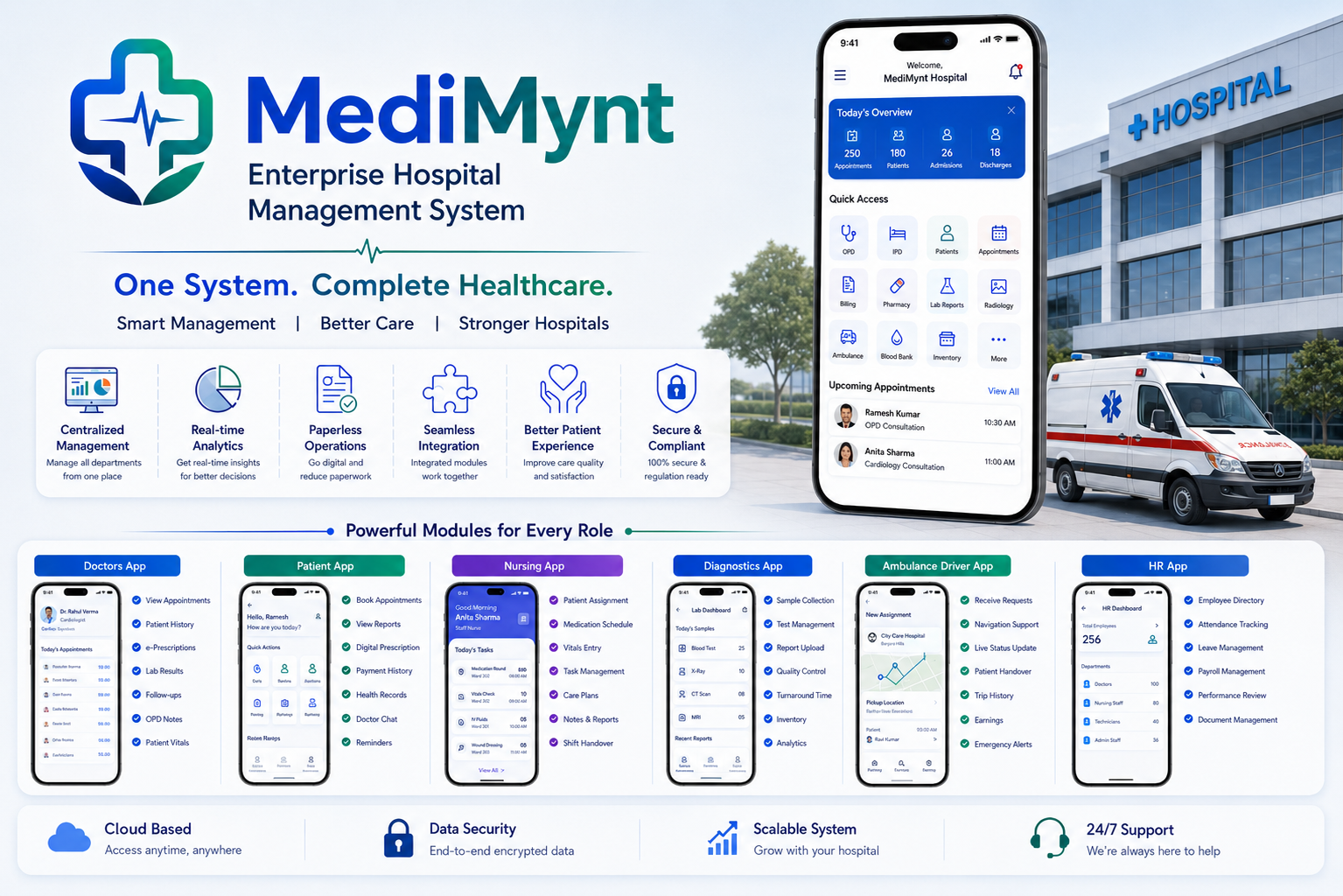
Most vendors list the same modules: OPD and IPD management, appointments, billing, pharmacy, lab, radiology, inventory. The difference is whether they share one patient record. A prescription written in the consultation room should already be visible at the pharmacy counter; a lab result should land in the doctor's app before the patient walks back. That is what paperless hospital operations actually means — not scanning paper into PDFs.
Every role needs its own tool
Hospitals are not one user type. Doctors need patient history and e-prescriptions at the bedside. Nurses need medication schedules, vitals entry and a structured shift handover. Diagnostics teams track samples and turnaround times; ambulance drivers need dispatch and navigation; HR runs attendance and payroll. Role-based apps — rather than one bloated screen with permissions — are what make staff actually use the system, and adoption is where most HMS purchases quietly die.
Analytics you act on the same day
Bed occupancy, appointments per department, pharmacy stock, lab turnaround — the value of real-time hospital analytics is operational, not decorative. If the numbers describe last month, they are a report; if they describe right now, they are a staffing and purchasing decision.
Security is a requirement, not a feature
Patient records are among the most sensitive data any business holds. End-to-end encryption, role-based access scoped per module, and audit trails are the floor for healthcare compliance — and cloud deployment should mean the 50-bed hospital and the multi-branch chain run the same, currently-patched software.
MediMynt is CodeMynt's enterprise hospital management system: OPD to payroll on one cloud platform, with six role-based apps for doctors, patients, nursing, diagnostics, ambulance drivers and HR. Request a demo and run the one-patient test on it yourself.
Questions answered
Frequently asked
What should a hospital management system include?
At minimum: OPD/IPD workflows, appointments, billing, pharmacy, lab and radiology, inventory and HR — sharing a single patient record so data entered once flows to every department without retyping.
Cloud-based or on-premise HMS — which is better?
Cloud-based hospital software means every branch runs the same, currently-patched version, scales from a 50-bed hospital to a chain, and is accessible from role-based mobile apps. On-premise mainly makes sense where regulation demands it.
How do you evaluate hospital software before buying?
Run the one-patient test: follow a single patient from registration through consultation, lab, pharmacy, billing and discharge in the demo. If any step requires re-entering data by hand, the modules are not truly integrated.